
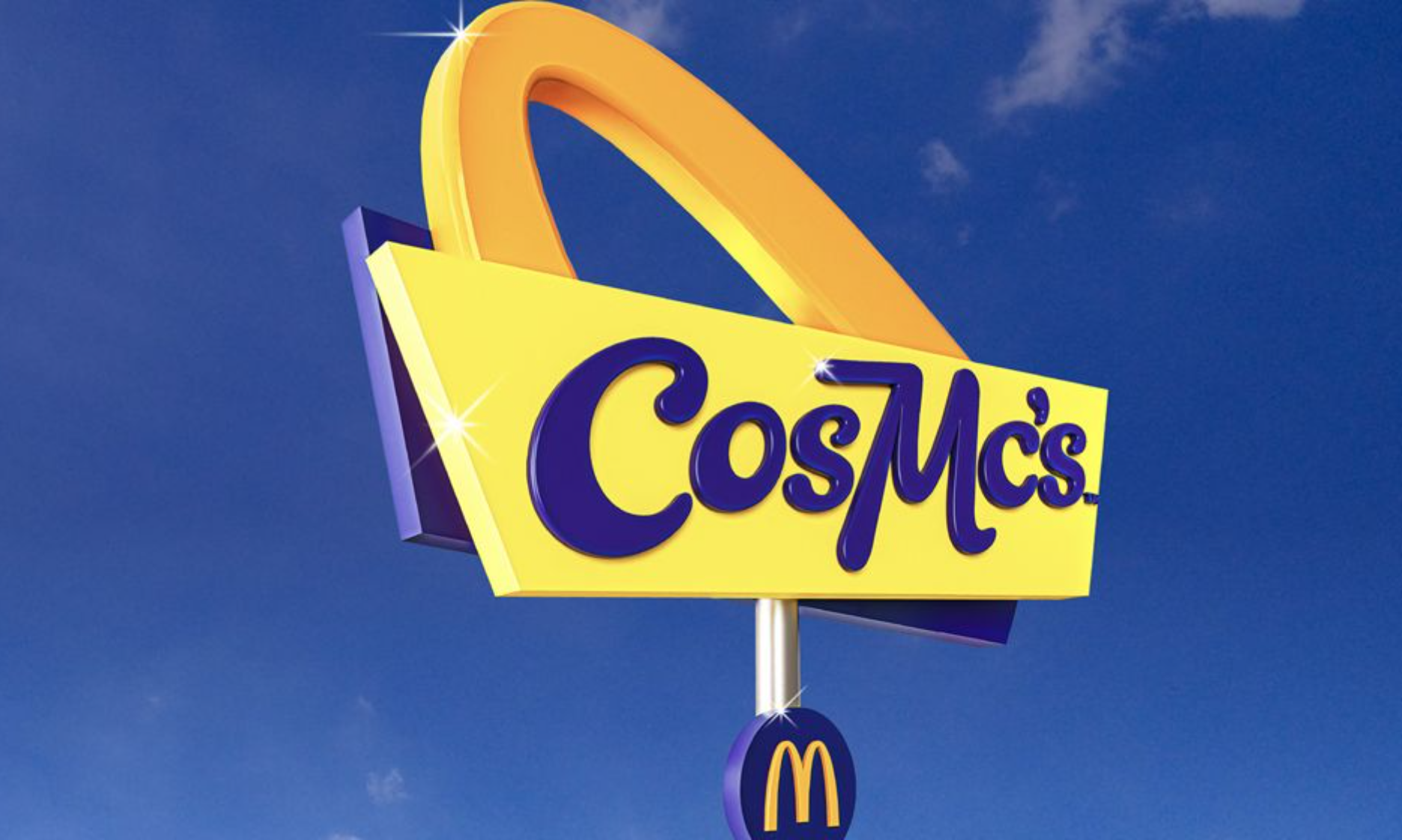
McDonald's launching specialty drinks chain
McDonald's is opening a new alien-inspired specialty drinks chain called CosMc in Illinois this month, stepping into territory that is dominated by the likes of Starbucks and Dunkin.
The fast food giant describes it as a "small-format, beverage-led concept" that will attempt to solve what it calls "the 3 p.m. slump."
McDonald's is opening a new alien-inspired specialty drinks chain called CosMc in Illinois this month, stepping into territory that is dominated by the likes of Starbucks and Dunkin.
The fast food giant describes it as a "small-format, beverage-led concept" that will attempt to solve what it calls "the 3 p.m. slump."
According to Forbes, the chain's name was inspired by a little-known mascot that appeared in McDonald's advertising during the 1980s and '90s.
McDonald's said that CosMc "seamlessly blends brand-new, otherworldly beverage creations with a small lineup of food, including a select few McDonald’s favourites." Drinks listed on its menu include Sour Cherry Energy Slush, Tropical Spiceade, and S’mores Cold Brew.
The company plans to have 10 CosMc stores open by the end of 2024, targeting the Dallas-Fort Worth and San Antonio metro areas. CEO Chris Kempczinski told investors last week that the "customizable drinks and coffee market" is worth $100 billion. "It’s a space that we believe we have the right to win,” he said.
MailOnline will begin charging for some stories
The Daily Mail's MailOnline website will begin charging readers to access select articles as soon as January, as it looks to diversify its revenues and become less dependent on advertising.
While the Financial Times reports that the "vast majority" of the articles posted on MailOnline each day will be free, readers will need a subscription to access around 10-15 high-value pieces. It represents a pronounced shift for the media brand, which is among the last holdouts when it comes to charging for content.
According to FT, the move was inspired by the German daily Bild, which has amassed 675,00 subscribers since pivoting to offering some paid-for content a decade ago.
With a reported 23.9 million monthly users, MailOnline is the second most-read news site in the UK, behind only the BBC. Readers in international markets, most notably the US, will not be affected.
X is now looking to small business for advertising
With owner Elon Musk's recent antics having mostly alienated large advertisers, X (formerly Twitter) is now setting its sights on the small businesses that have been so instrumental in the financial success of rivals like Meta and Alphabet.
According to The Wall Street Journal, X's advertising team is trying out partnerships with ad platforms that can "help it attract small and midsize businesses." WSJ said that one potential partnership is with Amazon.com that would make X ads available through the online retailer's ad-buying software.
"This deal, if reached, could draw in some of the millions of small and midsize businesses that peddle everything from paper clips to slipcovers on the e-commerce giant’s marketplace and buy ads through its tools," said WSJ.
The social platform has also reportedly held preliminary talks about providing access to some of its ad inventory to ad-tech company PubMatic. Those talks have stalled, but are likely to resume in the new year.
Rival companies like Google and Facebook have "found a gold mine in democratizing advertising," said WSJ, enabling companies of any size to easily purchase and measure ads. Meta reportedly serves over 10 million advertisers, many of which are small and medium-sized businesses.
YouTube is teens' preferred online destination: study
Teens are using video sharing platforms like YouTube and TikTok "almost constantly," according to a new study from the Pew Research Center.
In the study of 1,453 teens 13 to 17, nearly half (46%) said they are on the internet almost constantly, up from 24% in 2014-15.
YouTube is overwhelmingly a favoured destination, with 90% of teens saying they are on the platform. TikTok (63%), Snapchat (60%), and Instagram (59%) are also highly popular, while older platforms like Facebook and X have seen a steep decline in usage. The former, for example, has seen its use among teens fall from 71% in 2014-15 to 33% today.
About 13% of respondents indicated that they use the newer French platform BeReal, which aims to eliminate the artifice of platforms like Instagram by having users post a picture of their immediate surroundings at a different time each day.
The study also notes stark differences in habits among various ethnicities. Nearly one-third (32%) of Hispanics said that they are on TikTok almost constantly, for example, compared to 20% of Black teens and 10% of white teens.
TikTok crosses $10 billion in consumer spending
TikTok has become the first non-game app to generate $10 billion in in-app consumer spending, according to app intelligence provider data.ai.

The report said that TikTok added $3.8 billion in consumer spending over the course of the year. The report only tracks the app's consumer spending across iOS and Google Play, not third-party Android app stores in China, which likely means the total spend is higher.
The spending comes via in-app purchases of a virtual currency known as "coins" that users can spend on gifts for creators. Its most popular in-app purchase is a bundle of 1,321 coins that sells for $19.99, which represented one-quarter of the app's revenues. TikTok also generates additional revenue from advertising and ecommerce, although they weren't included in data.ai's analysis.
US consumers and Chinese iOS users accounted for 60% of spending, said the report, while markets including Saudi Arabia, Germany, the U.K. and Japan generated an additional 13% of revenues.
Data.ai is forecasting that TikTok will become the highest-earning app ever next year, hitting $15 billion in consumer spending.
McDonald's said that CosMc "seamlessly blends brand-new, otherworldly beverage creations with a small lineup of food, including a select few McDonald’s favourites." Drinks listed on its menu include Sour Cherry Energy Slush, Tropical Spiceade, and S’mores Cold Brew.
The company plans to have 10 CosMc stores open by the end of 2024, targeting the Dallas-Fort Worth and San Antonio metro areas. CEO Chris Kempczinski told investors last week that the "customizable drinks and coffee market" is worth $100 billion. "It’s a space that we believe we have the right to win,” he said.
MailOnline will begin charging for some stories
The Daily Mail's MailOnline website will begin charging readers to access select articles as soon as January, as it looks to diversify its revenues and become less dependent on advertising.
While the Financial Times reports that the "vast majority" of the articles posted on MailOnline each day will be free, readers will need a subscription to access around 10-15 high-value pieces. It represents a pronounced shift for the media brand, which is among the last holdouts when it comes to charging for content.
According to FT, the move was inspired by the German daily Bild, which has amassed 675,00 subscribers since pivoting to offering some paid-for content a decade ago.
With a reported 23.9 million monthly users, MailOnline is the second most-read news site in the UK, behind only the BBC. Readers in international markets, most notably the US, will not be affected.
X is now looking to small business for advertising
With owner Elon Musk's recent antics having mostly alienated large advertisers, X (formerly Twitter) is now setting its sights on the small businesses that have been so instrumental in the financial success of rivals like Meta and Alphabet.
According to The Wall Street Journal, X's advertising team is trying out partnerships with ad platforms that can "help it attract small and midsize businesses." WSJ said that one potential partnership is with Amazon.com that would make X ads available through the online retailer's ad-buying software.
"This deal, if reached, could draw in some of the millions of small and midsize businesses that peddle everything from paper clips to slipcovers on the e-commerce giant’s marketplace and buy ads through its tools," said WSJ.
The social platform has also reportedly held preliminary talks about providing access to some of its ad inventory to ad-tech company PubMatic. Those talks have stalled, but are likely to resume in the new year.
Rival companies like Google and Facebook have "found a gold mine in democratizing advertising," said WSJ, enabling companies of any size to easily purchase and measure ads. Meta reportedly serves over 10 million advertisers, many of which are small and medium-sized businesses.
YouTube is teens' preferred online destination: study
Teens are using video sharing platforms like YouTube and TikTok "almost constantly," according to a new study from the Pew Research Center.
In the study of 1,453 teens 13 to 17, nearly half (46%) said they are on the internet almost constantly, up from 24% in 2014-15.
YouTube is overwhelmingly a favoured destination, with 90% of teens saying they are on the platform. TikTok (63%), Snapchat (60%), and Instagram (59%) are also highly popular, while older platforms like Facebook and X have seen a steep decline in usage. The former, for example, has seen its use among teens fall from 71% in 2014-15 to 33% today.
About 13% of respondents indicated that they use the newer French platform BeReal, which aims to eliminate the artifice of platforms like Instagram by having users post a picture of their immediate surroundings at a different time each day.
The study also notes stark differences in habits among various ethnicities. Nearly one-third (32%) of Hispanics said that they are on TikTok almost constantly, for example, compared to 20% of Black teens and 10% of white teens.
TikTok crosses $10 billion in consumer spending
TikTok has become the first non-game app to generate $10 billion in in-app consumer spending, according to app intelligence provider data.ai.
The report said that TikTok added $3.8 billion in consumer spending over the course of the year. The report only tracks the app's consumer spending across iOS and Google Play, not third-party Android app stores in China, which likely means the total spend is higher.
The spending comes via in-app purchases of a virtual currency known as "coins" that users can spend on gifts for creators. Its most popular in-app purchase is a bundle of 1,321 coins that sells for $19.99, which represented one-quarter of the app's revenues. TikTok also generates additional revenue from advertising and ecommerce, although they weren't included in data.ai's analysis.
US consumers and Chinese iOS users accounted for 60% of spending, said the report, while markets including Saudi Arabia, Germany, the U.K. and Japan generated an additional 13% of revenues.
Data.ai is forecasting that TikTok will become the highest-earning app ever next year, hitting $15 billion in consumer spending.